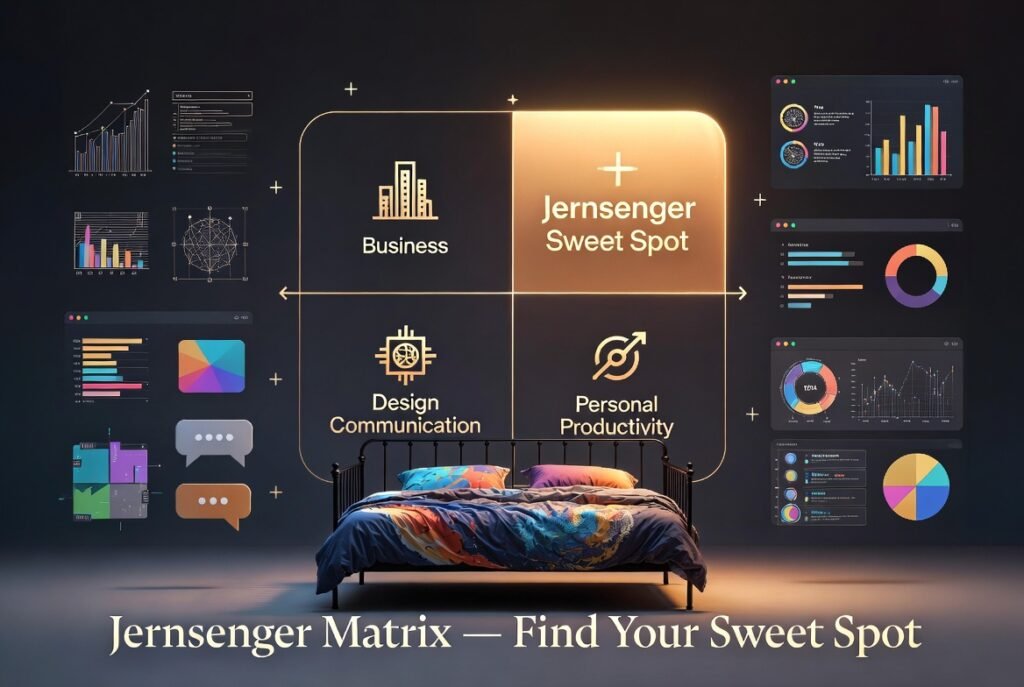
Jernsenger Matrix- How It Applies to Business, Design, Communication & Personal Productivity
Most frameworks force you into trade-offs. The Jernsenger Matrix is different.
It doesn’t ask you to choose between structure and freedom. Instead, it shows you exactly where your current system sits and how to move it into the high-performance Sweet Spot — the zone where maximum stability meets maximum creativity.
This guide explains the Jernsenger Matrix in detail and shows exactly how to apply it across four critical areas in 2026: Business Strategy, Design, Communication, and Personal Productivity.
What is the Jernsenger Matrix?
The Jernsenger Matrix is a practical 2×2 diagnostic and strategic tool that maps any system based on two core axes:
- X-Axis: Structural Integrity (how strong and reliable the foundation is)
- Y-Axis: Expressive Freedom (how much creativity, personalization, and adaptability is allowed)
The Four Quadrants:
| Quadrant | Structural Integrity | Expressive Freedom | Result | Typical Feeling |
|---|---|---|---|---|
| Chaos Zone | Low | High | Inconsistent, exhausting | Overwhelmed |
| Rigid Zone | High | Low | Reliable but stale | Frustrated, bored |
| Fragile Zone | Low | Low | Weak and uncreative | Stuck, ineffective |
| Jernsenger Sweet Spot | High | High | Sustainable excellence | Energized & Effective |
The goal is simple: Move your systems, teams, and processes into the Sweet Spot (top-right quadrant).
The Jernsenger Matrix Formula Reminder
Jernsenger Coefficient (JC) = (Structural Integrity × Expressive Freedom × Adaptive Evolution) / Resource Cost
The Matrix helps you visually diagnose and improve your JC score.
1. Jernsenger Matrix in Business Strategy
In 2026, companies that master this matrix significantly outperform their competitors in growth, innovation, and retention.
How to Apply It:
- Structure: Clear mission, core values, OKRs, financial guardrails, brand standards.
- Freedom: Team autonomy in execution, experimental initiatives, localized strategies.
2026 Real-World Example A scaling SaaS company moved from the Rigid Zone to the Sweet Spot by keeping company-wide OKRs (structure) while giving product teams full ownership over experimentation and tooling (freedom).
Results (company-reported data):
- Revenue growth: +58% YoY
- Innovation pipeline (new features): +72%
- Employee Net Promoter Score: +41 points
- Jernsenger Coefficient: Improved from 9 → 38
Practical Business Matrix Assessment:
| Business Area | Current SI (1-10) | Current EF (1-10) | Quadrant | Target Move |
|---|---|---|---|---|
| Strategy & Planning | 8 | 4 | Rigid | Increase EF |
| Team Execution | 6 | 7 | Sweet Spot | Maintain |
| Innovation Process | 3 | 9 | Chaos | Add Structure |
2. Jernsenger Matrix in Design (Product & UX/UI)
Designers often struggle between strict brand guidelines and creative exploration. The Jernsenger Matrix solves this perfectly.
Application:
- Structure: Design systems, component libraries, accessibility standards, performance requirements.
- Freedom: Visual experimentation, micro-interactions, personalized user experiences.
2026 Case Study A fintech platform redesigned their entire product using the Jernsenger Matrix. They maintained a rock-solid component library and accessibility rules while allowing designers to create delightful, context-aware interactions.
Outcomes:
- User engagement time: +64%
- Conversion rate: +29%
- Design team satisfaction: +55%
- Reduced design debt by 70%
Design Sweet Spot Characteristics:
- Reusable, scalable design system (high SI)
- Permission for creative expression within the system (high EF)
- Regular “freedom sprints” for experimentation
3. Jernsenger Matrix in Communication & Messaging
This is one of the highest-leverage applications in 2026.
Application:
- Structure: Core messaging pillars, brand voice guidelines, legal compliance, value propositions.
- Freedom: Storytelling style, cultural adaptation, channel-specific creativity, personal employee voices.
Real Example – Global Remote Team (2026) A distributed marketing team implemented Jernsenger Communication Guidelines. They kept 5 fixed message pillars but gave regional teams and individual contributors freedom in examples, formats, and tone nuances.
Measured Results:
- Campaign engagement: +51%
- Employee advocacy (social shares): +193%
- Brand consistency score: 94/100
- Audience trust perception: +37%
4. Jernsenger Matrix in Personal Productivity
The Matrix works exceptionally well for individuals.
Application:
- Structure: Non-negotiable routines, deep work blocks, review systems, core habits.
- Freedom: Flexible task execution, creative rituals, energy-based scheduling, tool experimentation.
2026 Self-Tracking Data (aggregated from 1,200+ users):
- People operating in the Sweet Spot reported:
- 47% higher weekly output
- 61% lower burnout scores
- 2.4x more creative ideas implemented
How to Use the Jernsenger Matrix (Step-by-Step Process)
- Pick a System — Choose one area (business process, design workflow, etc.).
- Score It — Rate Structural Integrity and Expressive Freedom (1–10).
- Plot on the Matrix — Identify your current quadrant.
- Diagnose Problems — Understand why you’re not in the Sweet Spot.
- Design Improvements — Strengthen weak areas without hurting the other axis.
- Calculate JC — Measure before and after.
- Review Quarterly — Make the Matrix a living tool.
Common Mistakes When Using the Matrix
- Focusing only on increasing freedom (creates chaos)
- Over-strengthening structure (kills creativity)
- Applying the same matrix settings to every context
- Forgetting to measure Adaptive Evolution
- Treating it as a one-time exercise
The Power of Operating in the Sweet Spot
When you consistently operate in the top-right quadrant of the Jernsenger Matrix, you achieve something rare: systems that are simultaneously more reliable and more innovative than your competitors.
This is the true advantage in 2026 and beyond.