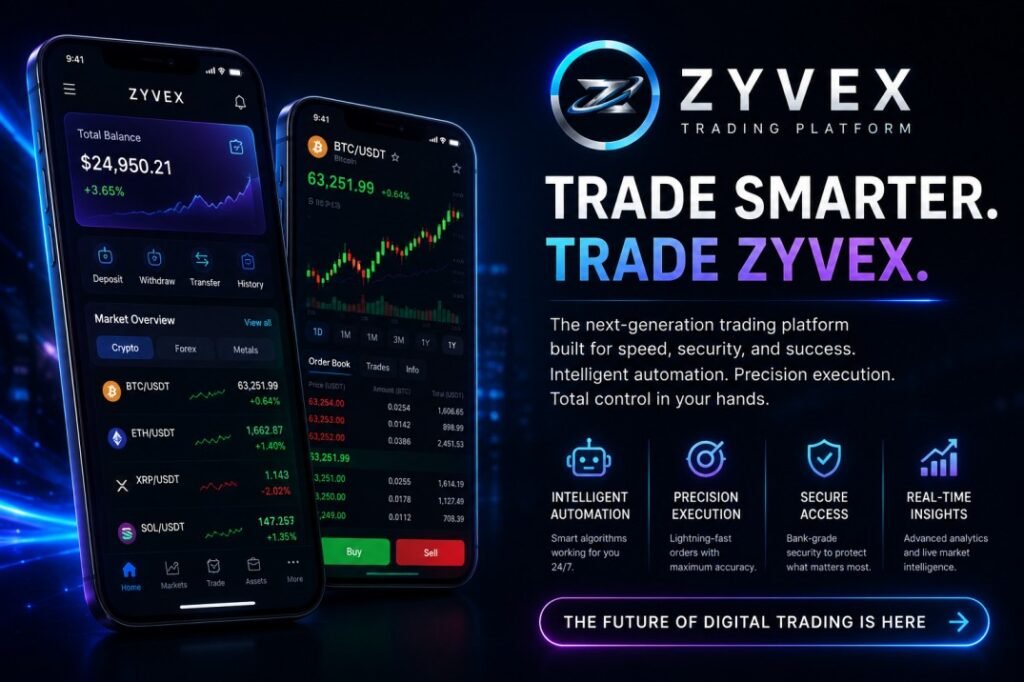
Five Years In, ZYVEX Is Proving That Fintech Longevity Comes From One Thing: Adaptability
The fintech graveyard is full of platforms that launched with momentum and stalled the moment market conditions shifted. They had good products. Some had great products. What they didn’t have was an architecture — strategic and technical — designed to absorb change rather than resist it.
ZYVEX isn’t on that list. And its fifth anniversary offers a genuinely useful case study in why some platforms survive and others don’t.
When ZYVEX launched in 2021, the digital trading landscape looked different than it does today. Retail investor participation was surging. Demand for sophisticated, automated trading tools was growing faster than the tools themselves. The infrastructure serving most traders was fragmented, clunky, or built for an earlier era of financial markets. ZYVEX entered that gap with a clear thesis: build a platform where automation, analytics, and execution don’t just coexist — they compound on each other.
Half a decade later, that thesis has held. The company is now announcing its next chapter, and the vision is considerably more ambitious than what was possible at launch.
The 2026 roadmap is centered on AI-powered predictive analytics and enhanced trading automation — technologies that push ZYVEX from reactive infrastructure into proactive market intelligence. This distinction matters more than it sounds. The difference between a platform that processes trades and one that anticipates market conditions is, increasingly, the difference between a utility and a competitive advantage. Traders who have access to the latter aren’t just executing faster — they’re operating with a qualitatively different kind of information.
Three strategic patterns stand out across ZYVEX’s five-year trajectory that other founders and platform builders should note carefully.
First, the company treated security as a product feature rather than a compliance function. In fintech, security is often treated as a cost center — something you invest in because you have to, not because it creates value. ZYVEX took the opposite view, continuously strengthening its security infrastructure and framing reliability as a core part of the user value proposition. That framing turned out to be correct. In a category where trust is hard to build and easy to destroy, consistent security performance has been a durable competitive advantage.
Second, ZYVEX kept the user experience central even as the underlying technology stack grew significantly more complex. This is harder than it sounds. As platforms accumulate capabilities — more analytics layers, more automation options, more data inputs — the natural tendency is for the interface to become more complicated and less intuitive. The platforms that avoid this trap are the ones that have strong product discipline and a genuine commitment to accessibility. ZYVEX’s growth trajectory suggests they built that discipline early.
Third, and perhaps most importantly, the platform was architected to adapt. The specific technologies ZYVEX is deploying in 2026 — AI, predictive analytics, advanced automation — weren’t fully mature when the company launched in 2021. But the system was built with enough flexibility that it can now absorb these capabilities without requiring a ground-up rebuild. That architectural foresight is rare. Most platforms are built for the moment, not for the next five years of technological change.
The competitive dynamics in digital trading have shifted significantly since ZYVEX’s founding year. Traditional financial institutions have accelerated their technology investments. Retail trading platforms have consolidated. The cost of building a credible trading platform has increased substantially as user expectations have risen. Entering the market now with ambitions comparable to ZYVEX’s early positioning would be orders of magnitude more difficult.
That context makes the five-year milestone more meaningful, not less. ZYVEX built its foundation during a window that may not reopen. The question now is whether it can translate that foundation into genuine leadership in the AI-powered trading era it’s now betting on.
The early indicators suggest it can. The platform’s investment in scalable infrastructure means it has the technical capacity to deploy AI capabilities at scale. Its user base provides the data depth that machine learning models require to be genuinely useful rather than just technically impressive. And its track record of consistent innovation suggests the organizational capability to execute on an ambitious roadmap.
What the market will watch is execution quality. Announcing AI capabilities is easy. Delivering predictive analytics that actually improve trading outcomes — that’s the hard part. The next twelve to eighteen months will be the proving ground.
For the broader fintech ecosystem, ZYVEX’s trajectory is worth studying regardless of how the AI chapter unfolds. The company has demonstrated that focus, adaptability, and consistent investment in foundational capabilities can build a durable platform in one of the most competitive segments of financial technology.
Five years is a long time in fintech. The fact that ZYVEX is using its anniversary to announce an expansion rather than a pivot suggests the foundation is genuinely solid. The future of digital trading belongs to platforms that can think, not just execute. ZYVEX is staking its next chapter on being one of them — and it has five years of evidence to support the bet.