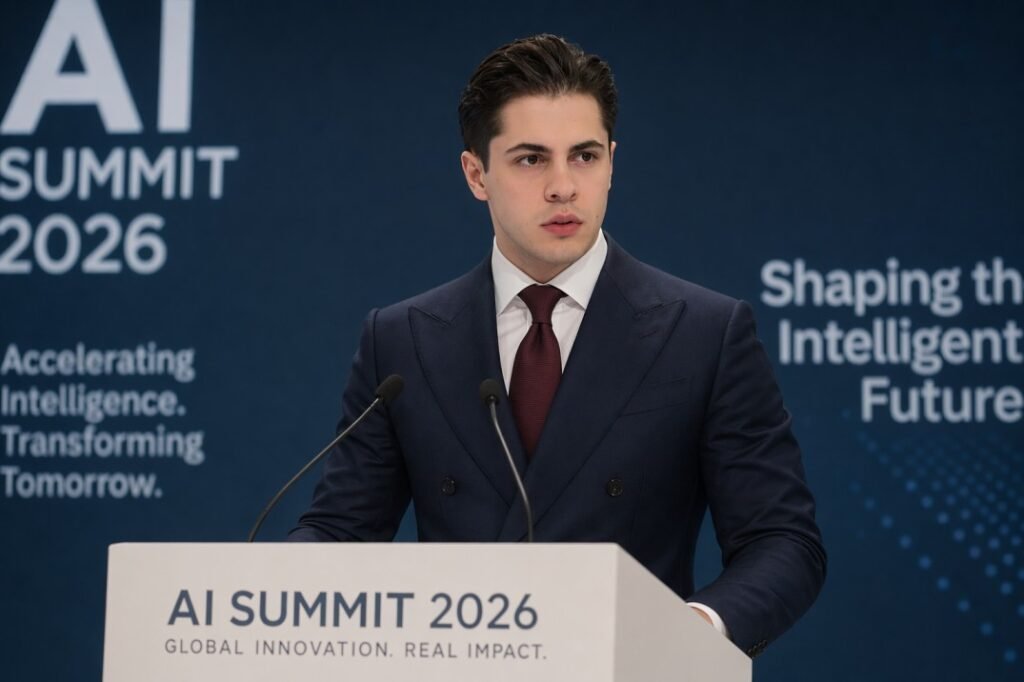
How a 21-Year-Old Became One of the Most Visible AI Builders in Asia
The number that Boris Kriuk explains is 2.5 kilobytes. That is the entire storage footprint of PSTNet, the atmospheric turbulence model he built — 552 learnable parameters, small enough to execute on a Cortex-M7 microcontroller, the kind of chip that costs a few dollars and sits inside equipment nobody would describe as a computer. Point it at a single weather observation and it returns a turbulence intensity map across eight flight levels, a 576-cell heatmap per altitude that a pilot or a dispatcher can read at a glance. Shown running live over the Central Asia–Himalaya corridor in February 2026, it identified severe cells at tropopause altitudes, terrain-blocked zones and the characteristic turbulence minimum of the lower stratosphere, from a data footprint smaller than a spreadsheet.
The reason that matters has nothing to do with the leaderboard. Boris is explicit about the target: oceanic, polar and data-sparse regions that lack operational nowcasting infrastructure altogether. Those are precisely the places a state-of-the-art atmospheric model cannot reach, because reaching them means shipping compute, bandwidth and budget that don’t exist there. A model that fits in 2.5 kB doesn’t have that problem. It is designed as a drop-in replacement for the legacy look-up tables still running inside resource-constrained onboard systems — not a demonstration of what is possible at the frontier, but a component someone can actually install. “We deliberately constrained the model to 550 parameters because we wanted to prove that physics does the heavy lifting, not scale,” Kriuk said. “The constraints are the intelligence — the network just learns the residuals that pure theory can’t capture.”
That is the thread running through everything he has built, and it is the reason his name travels further than his credentials should carry it. When an interviewer asked in October 2025 whether he accepted being called one of Hong Kong’s key AI figures at twenty-one, he brushed it off — “the external labels are a distraction from the actual work that needs to get done.” The work in question is not aimed at the capability frontier, where he could not compete and does not try to. It is aimed at the distribution frontier: the gap between where AI already works and where it can be afforded, trusted, audited and switched on. Almost the entire industry is pushing on the first constraint. He has spent two years pushing on the second, and the second is where deployment actually stalls.
His permafrost work shows what that looks like when the output is a decision rather than a device. Arctic warming threatens more than $100 billion in permafrost-dependent infrastructure, and the frameworks meant to assess that exposure have historically lacked spatiotemporal validation, uncertainty quantification and any operational decision-support layer. Kriuk’s hybrid physics-ML framework ingests 2.9 million observations from 171,605
locations, reaches accuracy under cross-validation designed to prevent leakage, and then does the thing that makes it usable: it classifies 15 per cent of zones as high-risk and 25 per cent as medium, with spatially explicit uncertainty maps showing where its own predictions are least reliable, and ships as open-source tooling intended to feed engineering design codes and adaptation planning. Under RCP8.5 forcing it projects a mean permafrost fraction decline of 20.3 percentage points, with 51.5 per cent of Arctic losing more than twenty. An engineer siting a pipeline can use that. The honesty about extrapolation is load-bearing rather than decorative — the model blends learned climate relationships at 60 per cent with hard physical sensitivity models at 40 per cent, because purely data-driven systems fail exactly where you most need them, outside the training distribution. A forecast that quietly breaks under warming it has never seen is worse than no forecast, since somebody will build on it.
With POSEIDON, his seismic work, the deliverable that will outlast the model is the dataset. Alongside a physics-informed architecture that embeds laws of nature as learnable constraints — and whose learned parameters converge to values a seismologist recognises — he released the Poseidon catalogue publicly on Hugging Face: 2.8 million events across thirty years, pre-computed energy features, spatial indices, standardised quality metrics. Anyone can now attempt aftershock identification, tsunami potential or foreshock detection without first spending months assembling a corpus. That is leverage of a different kind from a benchmark win. It lowers the cost of entry for everyone working the problem, including people who will never read his paper. And the interpretability is not aesthetic either: hazard science is a domain where a black box does not get adopted regardless of accuracy, because no regulator will sign off on a number nobody can explain. “Incorporating those laws directly into AI systems does not reduce predictive power,” he has said. “It improves it while preserving scientific interpretability.” Interpretability, in that context, is a deployment requirement wearing a scientific costume.
He seems to understand that the last barrier is not technical at all. In an August 2025 Hong Kong trade interview he appeared with SagaDigits founder Chan Chi-chuen to discuss a platform allocating work across human and machine workers by four factors — time, place, person, task. Kriuk’s contribution was the unglamorous structural one: human participation is in the foundational design, so people can intervene in and rewrite AI-drafted plans by construction rather than by exception. Chan insisted decision-making accountability stays with management and cannot be delegated to any AI system, and the pair validated with Hong Kong’s Electrical and Mechanical Services Department, on the reasoning that a government reference case dissolves enterprise hesitation faster than any accuracy figure. Then Chan named the binding constraint: data problems have solutions, security problems have solutions, culture does not. “Culture has to change all at once for it to mean anything.” Small, inspectable, overridable systems keep winning arguments that larger ones lose, and the reason is not performance. It is consent.
What Boris has built over years is a coherent bet, and it is more interesting than his age. The industry has spent six years treating intelligence as the scarce resource and access as a
detail to be sorted out later. Kriuk’s record inverts that: a turbulence model that fits on a microcontroller, a risk framework built to be handed to civil engineers, an earthquake catalogue given away, a workplace system designed to be overruled by the human in the room. His monograph, published in May 2026, is dedicated “to those who believe that intelligence is not scale, but adaptation,” and argues the next stage of AI “may not arrive through more parameters, but through fewer.” That is a thesis about who gets to use this technology. Boris started arguing it before he had a degree to fall back on, and the argument surprisingly does not depend on him being twenty-one as his ideas already drive attention worldwide.